Mastering Rapid Delivery with Spec-Driven Development (SDD)
Moving from prototyping to production requires a shift from "vibe coding" to Spec-Driven Development (SDD). This module teaches you how to leverage Native Claude Code capabilities—Memory (CLAUDE.md), Subagents, Tasks, and Hooks—to establish specifications as the authoritative source of truth. You will master the four-phase workflow that transforms ambiguous requirements into production-ready implementations, evolving from an implementation-first coder into a Spec-Driven Development (SDD) Practitioner capable of shipping complex systems with absolute fidelity and zero logic gaps.
The Evolution from Vibe Coding
The emergence of AI coding assistants has fundamentally altered how developers approach software creation. In the early days, developers quickly adopted vibe coding—an intuitive, conversational approach where developers describe what they want and receive code in return. This method works remarkably well for quick prototypes and exploring possibilities.
However, as practitioners moved from prototyping to building production systems, the limitations of vibe coding became apparent. Each iteration loses context from previous discussions. The agent makes reasonable assumptions that turn out wrong. The resulting code may work but does not align with the project's existing patterns or architecture.
Spec-Driven Development emerged as a response to these challenges. Rather than iterative discovery through conversation, SDD provides comprehensive specifications upfront. The AI agent receives a complete picture of what to build, why it matters, and critically—what NOT to build.
Prerequisites
This chapter builds directly on:
- Chapter 3 — You learned Claude Code's core capabilities: CLAUDE.md for persistent memory (Lesson 5), Subagent orchestration (Lesson 9), and the foundational tools that enable agentic workflows
- Chapter 4 — You learned context engineering: why context quality determines agent reliability, context isolation patterns (Lesson 9), and the Tasks system for persistent state (Lesson 4)
SDD is the methodology that orchestrates these capabilities into production-ready workflows.
SDD Tools Landscape
Spec-Driven Development is a methodology, not a single tool. Several frameworks implement it:
This chapter uses native Claude Code capabilities only—Memory (CLAUDE.md), Subagents, Tasks, and Hooks. No external frameworks required. The principles transfer to any SDD tool.
Claude Code has absorbed much of the SDD tooling natively: CLAUDE.md serves as the project constitution, subagents handle parallel research, the interview pattern (via ask_user_question) enables refinement, and the native Tasks system handles implementation delegation with dependency ordering and atomic commits.
📚 Teaching Aid
What You'll Learn
By the end of this chapter, you'll be able to:
- Explain why vibe coding fails for production systems
- Distinguish between the three SDD implementation levels (Spec-First, Spec-Anchored, Spec-as-Source)
- Design a project constitution that governs all specs, sessions, and subagents
- Execute the four-phase SDD workflow using native Claude Code features
- Design effective specifications that AI agents can implement reliably
- Apply parallel research patterns with subagents
- Use the Task system for dependency-aware orchestration with atomic commits
- Decide when SDD adds value vs when simpler approaches suffice
Key Prompt Patterns
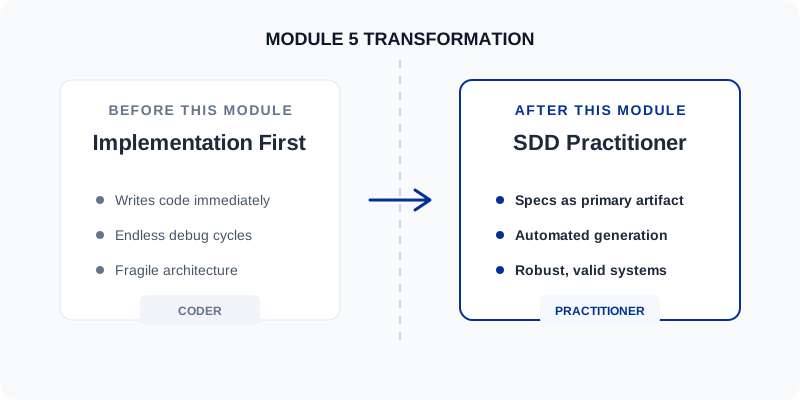
By finishing this module, you will transition from an implementation-first coder to a Spec-Driven Development (SDD) Practitioner. You will treat specifications as the primary product, allowing autonomous agents to handle the "how" while you master the "what" and "why."
References & Further Reading
This chapter synthesizes insights from:
- Osmani, A. (2025). "How to write a good spec for AI agents." addyosmani.com
- Böckeler, B. (2025). "Understanding Spec-Driven-Development: Kiro, spec-kit, and Tessl." martinfowler.com
- GitHub. (2025). "Spec-driven development with AI: Get started with a new open source toolkit." GitHub Blog
- Anthropic. (2025). "Claude Code: Best practices for agentic coding." anthropic.com/engineering
- Opalic, A. (2026). "Spec-Driven Development with Claude Code in Action." alexop.dev
For the complete academic foundation, see the Fista Solutions Research Paper: Spec-Driven Development with Claude Code: A Comprehensive Guide to AI-Native Software Development (February 2026).