Commanding General Agents: Mastering Claude Code and Cowork
You know why AI-driven development matters—and that it's happening right now, in 2026. But understanding transformation and experiencing it are two different things.
This chapter introduces you to Claude's General Agents—Claude Code and Cowork. These aren't just AI assistants; they're agentic AI systems that can reason through problems, make plans, and take action across domains.
What's a General Agent? An AI that observes, orients, decides, and acts—the OODA loop—executing actions rather than just generating text. Claude Code uses the terminal interface (for developers), while Claude Cowork uses the desktop interface (for knowledge workers). Both are powered by the same Claude Agent SDK.
The goal is not to build a supercomputer, but to establish Claude as your collaborative thinking partner for everything—and to build Skills that can become products.
Teaching Aid
What You'll Learn
By the end of this chapter, you'll have:
- General Agents Explained — Understanding why Claude's agentic AI is fundamentally different from passive assistants: the OODA reasoning loop, the Product Overhang insight, and filesystem access as the universal interface
- Two Interfaces, One AI — Claude Code (terminal-based for developers) and Cowork (desktop-based for knowledge workers), both running on the Claude Agent SDK
- Claude Code Installed & Working — Complete setup with multiple paths: Official Claude Pro/Max subscription (Lesson 2), OR free backends via OpenRouter, Gemini, or DeepSeek (Lesson 3)
- Hello World — Mastering the CLI interface (Lesson 4): slash commands, permission loops, and safe usage patterns
- Persistent Project Context — Creating CLAUDE.md files (Lesson 5) that eliminate repetitive context-sharing and establish team memory
- Practical Problem-Solving Exercises — 27 hands-on exercises across 8 modules (Lesson 6) building problem decomposition, specification writing, and quality verification skills
- Teach Claude Your Way — Mastering custom instructions (Lesson 7) to align Claude's behavior with your personal or team standards
- Autonomous Expertise — Agent Skills (Lessons 8-9) with prompt patterns (Persona + Questions + Principles)
- Agent Skills Exercises — 27 hands-on exercises (Lesson 10) from skill anatomy to production-ready skill suites and capstone projects
- Subagent Orchestration — Recognizing when Claude automatically delegates to specialized agents (Lesson 11) for complex tasks
- External Integration — MCP servers (Lesson 12) for safe access to external systems
- Token Optimization — Compiling MCP servers to Skills (Lesson 13) for 80-98% token reduction
- Configuration Mastery — Settings hierarchy (Lesson 14) and precedence rules for team collaboration
- Event-Driven Automation — Hooks (Lesson 15) for custom behaviors triggered by events
- Complete Extensibility — Discovering and using plugins (Lesson 16)
- Autonomous Iteration — The Ralph Wiggum Loop (Lesson 17) for self-correcting workflows
- The Creator's Workflow — How Boris Cherny (Lesson 18) uses Claude Code effectively
- Plugins & Extensibility Exercises — 15 hands-on exercises across settings, hooks, plugins, and autonomous iteration (Lesson 19)
- Agent Teams — Coordinating multiple Claude instances as a team with TeamCreate, TaskCreate, and SendMessage (Lesson 20)
- Agent Teams Exercises — 10 hands-on exercises practicing team creation, task coordination, quality hooks, and multi-agent workflows (Lesson 21)
- Worktrees — Parallel agent isolation using git worktrees for safe, independent workstreams (Lesson 22)
- Remote Control — Sessions without boundaries: control local Claude Code from any device via secure relay (Lesson 23)
- Claude Cowork Fundamentals — From terminal to desktop (Lesson 24), getting started (Lesson 25), and practical workflows (Lesson 26)
- Browser Integration — Claude in Chrome (Lesson 27) for web-based automation
- Plugins and Connectors — (Lesson 28): pre-built integrations with Google Workspace, Notion, Slack, and more
- Safety, Limitations & What's Coming — Understanding boundaries, responsible use, and the future of agentic AI (Lesson 29)
- Built-in Document Skills — Working with docx, xlsx, pptx, and pdf files (Lesson 30)
- Decision Framework — Choosing between Code and Cowork (Lesson 31)
- From Skills to Business — Understanding how Skills become monetizable products (Lesson 32), the Digital FTE model, and the path to revenue
- Cross-Vendor Landscape — How Claude Code concepts (CLAUDE.md, Skills, MCP, hooks, teams) map to OpenAI Codex, Google Gemini CLI, and emerging industry standards (Lesson 33)
- Chapter Quiz — 50-question interactive assessment (Lesson 34) covering all chapter concepts
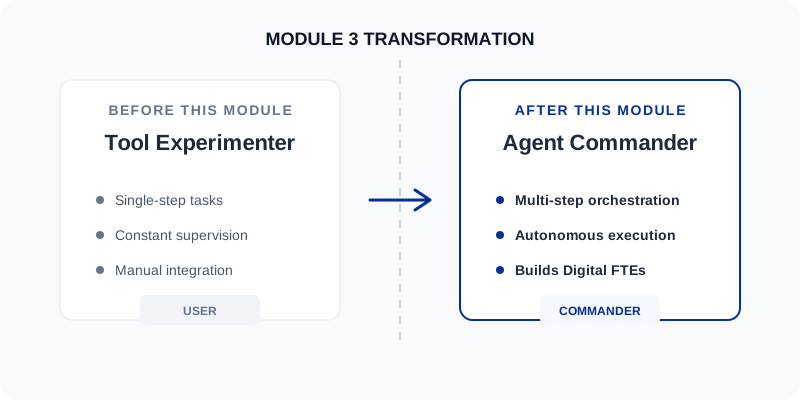
By finishing this module, you will transition from a tool experimenter to an Agent Commander. You will move beyond chatting with AI to commanding autonomous agents that execute complex, multi-file workflows, turning your workstation into a factory of digital labor.