Practical Orchestration: Real-World Foundations Examples
The shift to Digital FTEs: Engineering (AIDE) is not just about using better tools; it is about a fundamental change in Agent Maturity. This lesson demonstrates how the theoretical foundations of Module 1—the M-Shaped Developer, the Nine Pillars, and the transition from Typist to Orchestrator—translate into high-velocity engineering workflows.
Example 1: The Maturity Shift (From Typist to Orchestrator)
The Scenario
A legacy monolithic authentication service needs to be migrated to a modern, containerized microservice architecture. The current system is 5 years old, written in an older version of Node.js, and has tightly coupled dependencies that make it a "Nightmare to Maintain."
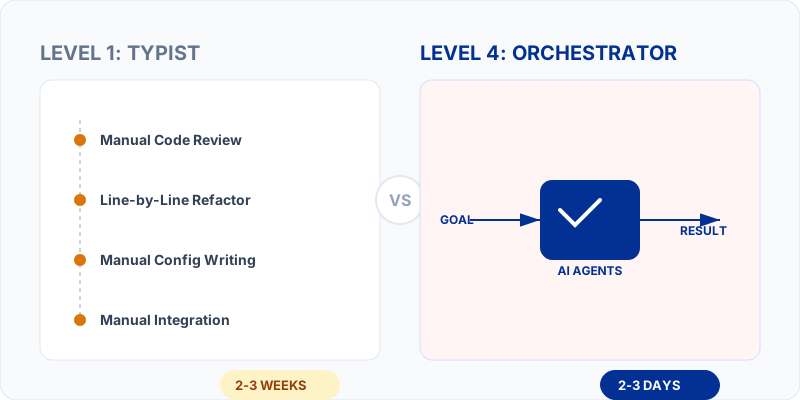
The Level 1 Approach (The Typist)
The engineer treats the AI as a search engine or a syntax corrector. They manually read every file, copy-paste snippets into a chat window, and ask, "How do I dockerize this?" They then manually apply the changes, debug the build errors themselves, and spend weeks on "trial and error."
- Outcome: 2-3 weeks of manual labor; high risk of "Refactoring Burnout."
The Level 4 Approach (The Orchestrator)
The engineer acts as the Director. They command a General Agent: "Analyze this monolith. Create a migration plan that follows the Strangler Fig pattern. Refactor the auth logic into a separate /auth service, generate a multi-stage Dockerfile, and verify the migration with a suite of integration tests."
The "How" (Orchestration in Action):
- Observe: The agent maps the dependency graph of the monolith using terminal tools.
- Orient: It identifies that the UserManager is the core bottleneck and proposes a plan to extract it first.
- Decide: It selects the best base image for Docker and the most efficient CI/CD workflow for the target cloud provider.
- Act: It writes the code, the config, and the tests in parallel, self-correcting as it encounters lint errors.
Detailed Analysis: This represents the Agent Maturity Model. The Orchestrator isn't "coding" anymore; they are validating outcomes. They have offloaded the "cognitive drudgery" of the migration to the agent, reducing the timeline from weeks to a single weekend.
Example 2: The M-Shaped Developer (Scaling Individual Breadth)
The Scenario
A Backend Engineer is tasked with building a "Real-Time User Analytics Dashboard." Traditionally, this would require a Frontend Engineer for the UI, a DevOps Engineer for the deployment, and a Backend Engineer for the API.
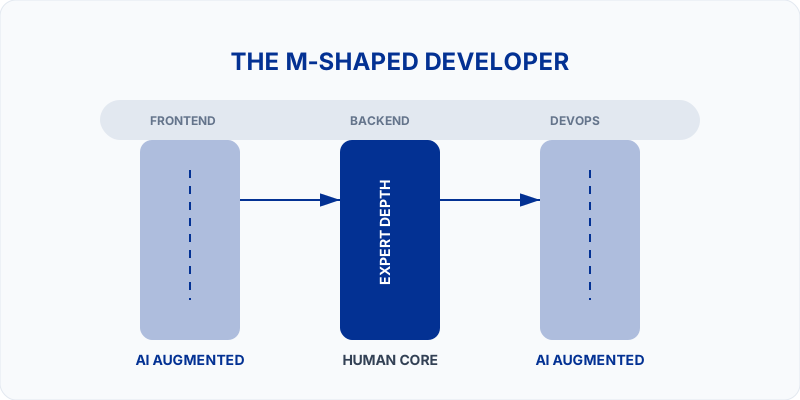
The Traditional Approach (The Specialist Bottleneck)
The project stalls for 3 weeks waiting for "Frontend resources" to become available. When the UI is finally ready, it doesn't match the API schema exactly, leading to another week of "Handoff Friction."
The M-Shaped AIDD Approach (The One-Person Team)
The engineer uses their Deep Domain Expertise (Backend) to secure the logic, while using AI agents to provide the Breadth needed for the rest of the stack.
The "How" (Breadth via AI):
- Frontend Generation: The engineer commands: "Build a high-performance React dashboard using Tailwind CSS and shadcn/ui. Connect it to our analytics websocket and implement real-time charting with Recharts."
- DevOps Orchestration: "Create a Terraform script to deploy this as a serverless application on AWS. Include CloudFront for globally distributed caching and automated SSL via ACM."
- Cross-Domain Verification: The agent runs the full-stack tests, ensuring the frontend, backend, and infra are perfectly synced.
Detailed Analysis: This is the M-Shaped Developer in action. AI doesn't replace the engineer; it removes the Specialization Tax. A single person can now deliver a production-ready system that previously required an entire multi-disciplinary team.
Example 3: Solving Complexity with the Nine Pillars
The Scenario
Building a mission-critical "Financial Transaction Processor" that must handle 10,000 requests per second with 99.99% uptime and zero data loss. This is a "High-Stakes" engineering challenge where failure is not an option.
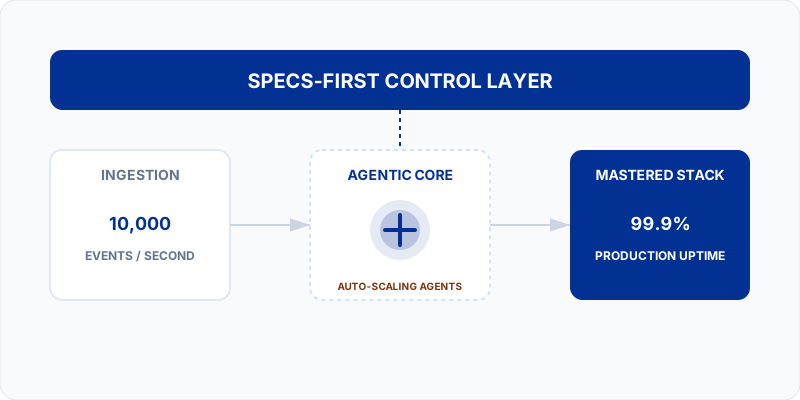
The Systematic Solution (Real-World Pillars)
Instead of "Vibe Coding," the engineer applies the Nine Pillars of AIDD to ensure deterministic success.
The "How" (Applying the Pillars):
- Specs First: The engineer writes a strict TRANSACTION_SPEC.md before a single line of code is written. This spec defines the "Exactly-Once" delivery semantics and the database ACID requirements.
- Task Atomic Decomposition: The agent breaks the build into 14 atomic steps. Each step (e.g., "Implement Idempotency Logic") is a separate sub-task with its own verification gate.
- Verification as Primary Workflow: Every implementation step includes an automated "Stress Test" script that simulates high-load scenarios. The agent is not allowed to commit code unless the stress test passes.
- Persisting State (CLAUDE.md): A CLAUDE.md file tracks every architectural decision made during the 5-day build, preventing "Assumption Drift" as the complexity grows.
Detailed Analysis: Complexity is solved by Constraint. By using the Nine Pillars, the engineer creates a "Circle of Truth" where the AI agent is forced to be precise. The result is a system that is not just "built fast," but is architecturally superior to one built through manual Specialist labor.
Key Takeaway
Real-world foundations are about Leverage. The Orchestrator mindset and the Nine Pillars are the "Lever" that allows a single engineer to command an army of Digital FTEs. You are no longer judged by how many lines of code you write, but by the complexity and scale of the systems you can reliably orchestrate.