How This Book Will Be A System Of Record For The Agent Era
The Spec-Driven Blueprint for Building and Monetizing Digital FTEs—Reliable AI Agents You Can Trust, Deploy, and Scale
A practical framework for engineers, domain professionals, enterprise leaders, product architects, and operational teams building the next generation of AI-powered organizations.
It is 8:07 a.m. A project manager is already behind on reporting. A finance lead is reconciling numbers across disconnected systems. An operations team is waiting for answers that should have arrived yesterday. Instead of opening ten dashboards, chasing five people, and stitching together decisions by hand, they assign the work to a Digital FTE — an AI employee that follows specifications, uses approved tools, works within human oversight, and produces outputs the organization can actually trust.
That is the promise of this book.
This book is not about chatbot tricks, impressive demos, or short-lived prototypes dressed up like strategy. It is about building dependable AI workers that can participate in real business operations. These systems do not replace human judgment. They extend it, scale it, and make it repeatable.
In this book we introduce the concept of a Digital FTE (Full-Time Equivalent employee) — AI agents that can perform real work inside organizations, just like a human employee. In traditional organizations, an FTE represents the work capacity of one full-time human employee. A Digital FTE is the AI equivalent: an intelligent agent or digital worker that can perform tasks, execute workflows, analyze information, and assist teams inside real organizational systems. Unlike human employees, Digital FTEs can operate continuously, scale instantly, and be deployed in large numbers. As AI systems mature, organizations will increasingly build teams composed of both human employees and Digital FTEs working together — forming hybrid workforces that combine human judgment with machine intelligence.
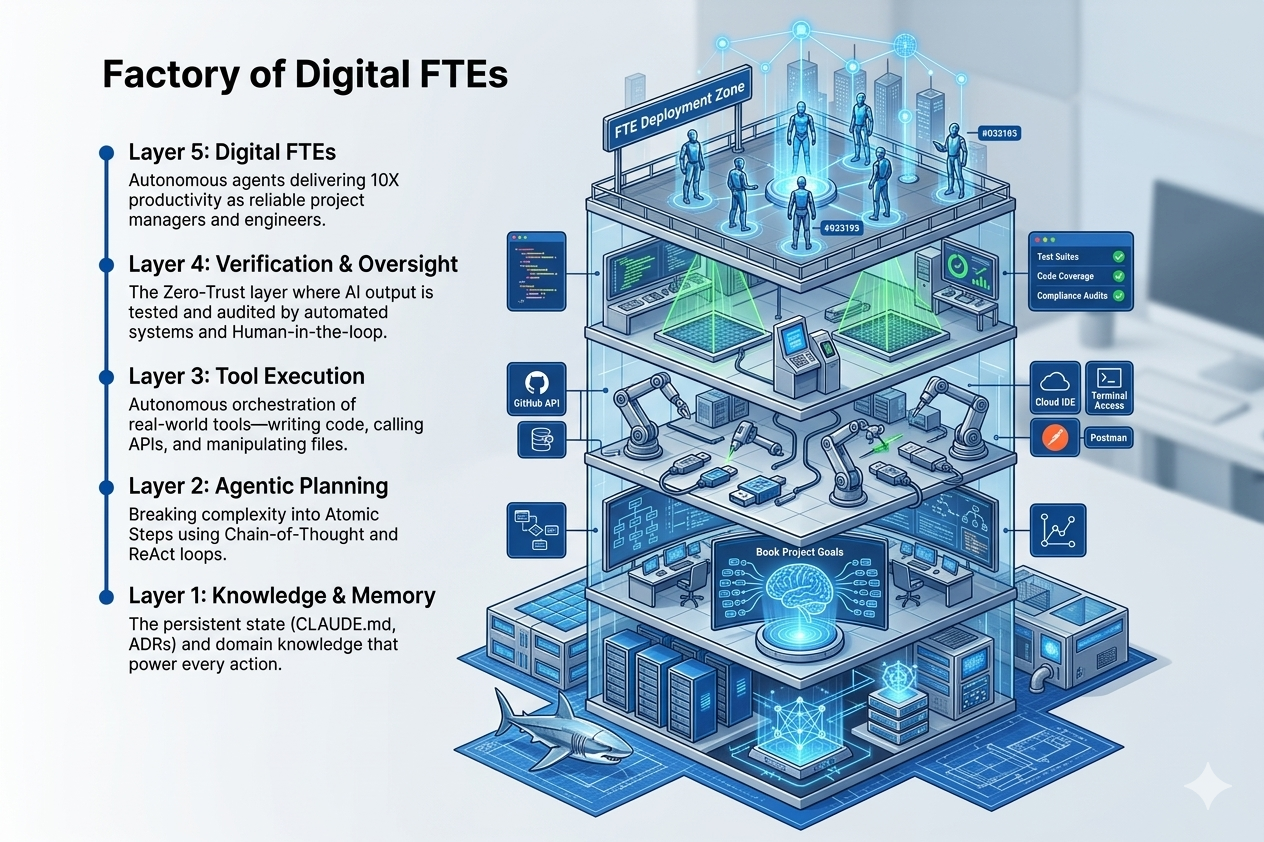
Modern AI is built like a towering five-layer cake — a metaphor popularized by Jensen Huang, CEO of NVIDIA. At the base lies Energy, powering vast data centers around the world. Above it sit Chips, the specialized processors that perform trillions of calculations every second. On top of that comes Infrastructure — the global network of supercomputers and cloud platforms that scale those computations. Above the infrastructure are Models, the neural networks that learn, reason, and generate intelligence. And finally, at the very top, sits the fifth layer: Applications — where AI stops being technology and starts becoming useful.
Billions of dollars are invested in the lower four layers so that this fifth layer can exist. This book is about that fifth layer. It teaches you how to build the applications, agents, and digital workers that transform AI capability into products people use, workflows organizations rely on, and value enterprises can capture.
The lower layers matter because they make the top layer possible. Models, infrastructure, and hardware are essential, but they do not create business value on their own. Value appears when intelligence is shaped into workflows, products, services, and operational systems that people can actually use.
The next competitive gap between organizations will not come only from who has the best model, the biggest GPU cluster, or the flashiest prototype. It will come from who can turn intelligence into repeatable execution. In the same way that software transformed manual processes into digital systems, Digital FTEs will transform structured knowledge work into scalable operational capability. The organizations that learn to build them well will move faster, preserve expertise better, and create entirely new forms of leverage.
The mission of The Digital FTEs is to help you design and build these systems — so that AI becomes not just powerful, but useful, governable, and economically meaningful.
The Core Idea
At the center of this book is a simple idea:
Digital FTEs — also called Digital Workers — are reliable AI agents designed to perform structured knowledge work continuously inside real organizational environments.
A Digital FTE is not just a model with a prompt. It is a system. It combines domain expertise, explicit specifications, engineering architecture, and human oversight so that work can be performed consistently, auditable, and at scale.
The AI Digital FTEs introduces a systematic approach for designing and deploying Digital FTEs—AI agents that transform human expertise into scalable digital workers.
Rather than focusing only on large language models, this book explains how dependable agent systems emerge from the combination of four critical elements:
- Structured Specifications — Clear definitions of what agents must do.
- Domain Expertise — The "knowledge engine" that guides reasoning and decision-making.
- Engineering Architecture — The infrastructure that ensures reliability and scalability.
- Human Oversight — The feedback loops that maintain accountability and governance.
Together, these elements enable the creation of agent systems that organizations can trust, deploy, and scale.
Digital FTEs are not only a technical construct; they are an economic one. They allow organizations to package expertise, reduce execution bottlenecks, improve consistency, and create new service models, internal capabilities, and revenue streams. Built well, they do not merely automate tasks. They become scalable assets.
Who This Book Is For
This book is written for the cross-functional teams building the Agentic Enterprise, including:
- AI Developers & Architects — Building production-grade, reliable agent systems.
- Subject Matter Experts — Transforming niche expertise into reusable AI skills.
- Enterprise Executives — Guiding responsible and scalable AI adoption.
- Product Managers — Translating complex business workflows into agent capabilities.
- Operational Teams — Applying AI agents to solve real organizational bottlenecks.
Together, these groups form the collaborative foundation required to build Digital FTEs—a new class of digital workers designed to extend human expertise and unlock new economic value.
These groups often speak different professional languages, chase different priorities, and measure success in different ways — a meeting-room comedy with no laugh track. But Digital FTEs can only be built well when these groups work together.
This book gives them a shared framework.
Why This Book Exists
Most organizations today approach AI through isolated experiments: a prototype here, a chatbot there, a promising workflow demo that never quite makes it into daily operations.
What is missing is not excitement. What is missing is method.
Very few organizations have developed a repeatable way to build reliable AI agents that can function as a real part of the workforce. They may have access to strong models, talented people, and business demand, yet still lack the design discipline required to convert those ingredients into dependable digital workers.
This book introduces that method.
It explains how to identify valuable AI employee opportunities, turn expert knowledge into structured specifications, design bounded agent workflows, deploy them on reliable cloud-native infrastructure, and govern them with human oversight. In other words, this book is about building an Digital FTEs: a repeatable capability for producing intelligent digital workers again and again.
By the end of this book, you will not simply understand agentic AI as an idea. You will understand how to manufacture dependable Digital FTEs as an organizational capability.
This Book Is Infrastructure, Not Just Text: Three Modes of Delivery
Most books are written to be read. This book is written to be read, to teach through an AI tutor, and to guide an AI building partner — all from the same knowledge base. It is not just a book. It is the foundation of a learning and development ecosystem designed for three modes of delivery.
Mode 1: Human Reading. The traditional path. You read the chapters, study the frameworks, complete the exercises, and build deployable artefacts. Every chapter in this book stands on its own as a self-contained unit of professional education. This mode is what the Reader Guide below describes.
Mode 2: TutorClaw — Your Personal AI Tutor. TutorClaw is a teaching agent that uses this book as its knowledge foundation. It runs 24/7 with persistent memory across WhatsApp, Telegram, and web — meeting you where you already are. It teaches you step-by-step. When you ask TutorClaw to explain IFRS 9 staging or walk you through a SKILL.md for contract review, it draws on the same domain knowledge, the same governance principles, and the same jurisdiction-aware frameworks that the chapters contain. But it adapts to your pace, your background, and your questions in real time. The book gives TutorClaw its expertise. TutorClaw gives the book a voice.
Mode 3: The FTE Development Plugin — Your AI Building Partner. The FTE Development Plugin for Claude Code uses this book as its operational playbook. When you are building a Digital FTE — writing the spec, structuring the SKILL.md, defining escalation protocols, configuring MCP connectors — the plugin guides you through the development workflow step by step, drawing on the patterns, templates, and domain knowledge encoded in every chapter. Where TutorClaw teaches you the theory, the FTE Plugin walks beside you during construction. It is the difference between reading about how a factory works and having a foreman on the floor.
Why this matters. The same knowledge base powers all three modes. When a chapter is updated — a new jurisdiction overlay for banking compliance, a refined escalation protocol for legal ops — the update propagates to TutorClaw's teaching and the FTE Plugin's guidance simultaneously. The book is not a static artefact. It is the single source of truth for an ecosystem: human learning, AI tutoring, and AI-assisted building, all drawing from one authoritative foundation.
A System of Record for the Agent Era
Jensen Huang, CEO of NVIDIA, has argued that AI agents do not eliminate the need for systems of record — they reinforce it. Agents need ground truth. They need authoritative places to read from, write to, and verify against. Without that foundation, agents hallucinate. With it, they execute.
Huang is solving this for the enterprise. The databases, workflows, and operational platforms that companies have spent decades building become more essential in the agent era, not less. Agents do not replace SAP or ServiceNow. They use them — at machine scale.
But there is a layer Huang is not solving for: the human layer.
Millions of developers, architects, and domain professionals are about to build AI agents. Most of them have no canonical source to learn from. No structured body of knowledge that has been designed for verification, not just consumption. They are learning from scattered tutorials, outdated blog posts, and model outputs that may or may not reflect how production agent systems actually work.
The AI Digital FTEs is a system of record for agentic AI education.

This is not a metaphor. The book's architecture follows the same pattern Huang describes for enterprise systems:
- The book is the canonical source of truth — the authoritative knowledge base that defines what agents are, how they are built, and how they are governed.
- TutorClaw is the agent — it reads from the book, not the open internet, and teaches from verified knowledge rather than probabilistic generation.
- Human judgment is the verification layer — students and instructors confirm that what TutorClaw teaches and what the FTE Plugin builds matches the book's intent. This is the final 10% of the 10-80-10 pattern.
This is the system-of-record pattern applied to education itself. The same pattern that makes enterprise agents trustworthy — structured source, bounded agent, verified output — is what makes this learning ecosystem trustworthy.
And there is a deeper symmetry at work. This book does not merely use a system of record. It teaches you how to build agents that use systems of record. The architecture of the learning system and the content of the curriculum mirror each other. You learn the pattern by experiencing it.
Huang solved verification for the enterprise. This book solves it for the people who will build those enterprises.
Reader Guide
This book is written for readers coming from different disciplines, but all of them are participating in the same larger project: building the Agentic Enterprise.
Building these systems requires collaboration across multiple disciplines. This book is written for the cross-functional teams responsible for building the Agentic Enterprise.
AI Developers, Software Engineers & Platform Architects
The Builders
Developers and architects are responsible for turning the promise of agentic AI into production-grade systems. While many AI applications remain fragile prototypes, this book introduces a systematic engineering approach to:
- Design agents using spec-driven development.
- Build scalable systems with cloud-native architectures (Docker, Kubernetes, Dapr).
- Implement secure and auditable tool interfaces.
- Structure reusable skill libraries that encapsulate domain expertise.
Subject Matter Experts & Domain Professionals
The Knowledge Holders
The most valuable AI systems depend on deep domain knowledge. Professionals in accounting, law, finance, and supply chain possess judgment that serves as the guiding structure for AI behavior. You will learn to encode expertise into structured artifacts—specifically SKILL.md specifications—ensuring that:
AI executes routine reasoning, while professionals provide judgment, oversight, and accountability.
Enterprise Executives & Technology Leaders
The Decision Makers
Senior leaders must move from isolated experimentation to reliable enterprise deployment. This book provides a strategic roadmap for:
- Establishing governance models and risk controls.
- Implementing human-in-the-loop supervision.
- Executing phased adoption from pilot programs to enterprise-wide scale.
AI Product Managers & Solutions Architects
The Translators
You play a critical role in decomposing complex business processes into automated tasks. This book offers practical guidance for:
- Mapping workflows into agent skills.
- Defining boundaries between automated reasoning and human decision-making.
- Designing verifiable outputs and evaluation processes.
Department Leaders & Operational Teams
The Operators
Department leaders often manage workflows that are highly structured but time-intensive. This book shows how to transform internal playbooks into repeatable agent workflows to:
- Reduce repetitive analytical work and improve consistency.
- Extend expertise across the entire organization.
- Build digital capabilities that operate continuously.
Building the Agentic Enterprise
Agentic AI introduces a new class of digital workers capable of performing structured reasoning at scale. But these systems do not emerge from models alone. They emerge from disciplined collaboration between engineers, experts, product thinkers, operators, and leaders.
That is why The AI Digital FTEs matters.
Its purpose is to provide a shared blueprint for building reliable Digital FTEs — not as isolated experiments, but as part of a broader organizational capability.
The goal is simple: move beyond AI curiosity and into AI execution.
In the Agentic Enterprise, human judgment and scalable machine reasoning work together. Expertise becomes operational. Workflows become repeatable.Capabilities become products. And organizations gain a new kind of workforce: digital, dependable, and built by design.